
Across this series we have looked at why retirement matters for our generation, and how to begin planning. Part two laid out the building blocks for finding the type of option that suits you. Now, we will take a look at the menu of options and the plans that TTUTC offers to help you choose the best fit for your life that matches your goals, your timeline, and how comfortable you are with risk.
The hard truth about NIS: don’t lean on it alone
Before any plan you choose, there is one you already have. NIS, the national insurance pension, is funded through contributions from your salary, and it gives a basic income in retirement. It matters, but here is the honest part; NIS has been under growing strain for years. Benefit payments have climbed to more than $6 billion a year, up about 65% over two decades, and since 2020 the fund has been paying out more than it collects, which means drawing down its reserves to keep up.
A formal review warned that, without changes, those reserves could come under serious pressure within about eight years. The response has been to raise the pension age from 60 to 65, phased in between 2028 and 2036. The goalposts have already moved once, and the pressures behind that have not gone away.
None of this means NIS is disappearing or that you should panic. It highlights something simpler and more useful: NIS was never built to be your whole retirement, and leaning on it alone is a risk no young person should take. The minimum pension is $3,000 a month. The amount is not based on how much money you personally paid in, but on how many contributions you’ve made over your working life, the earnings classes attached to those contributions and your average contribution rate over time.
Picture the life you want in your sixties and seventies. For almost everyone, that figure on its own, would not cover it. Treat NIS as the base you stand on, not the roof over your head, and build the rest yourself.
TTUTC Retirement Plans
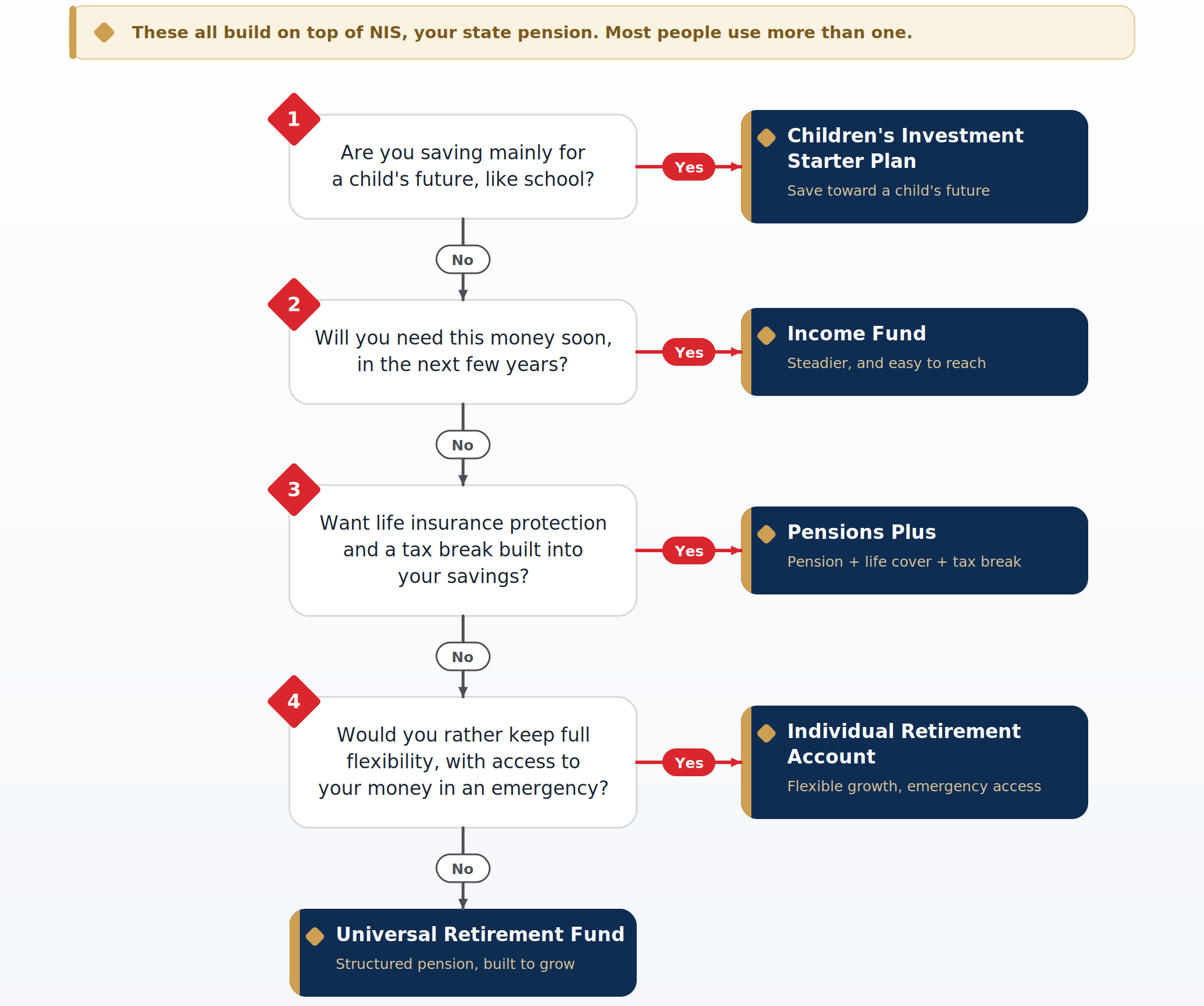
TTUTC specializes in the growth and pension side of that menu, with a handful of plans built for different stages and styles. Before we get into the details, use this quick decision tree to see which UTC option best aligns with your goals and savings style.
Universal Retirement Fund
What it is: An investment-linked pension plan for self-employed people and businesses. Your contributions are invested across local and international shares, bonds and high-income securities, and the value of your account grows along with those investments.
Best for: People who are self-employed or running a business, who want a structured, disciplined pension and are happy to leave the money growing until retirement.
What affects how much you get: How much and how long you contribute, and how the underlying investments perform over the years.
The trade-offs: The money is designed to stay invested until retirement, with access allowed only for serious events like permanent disability or buying a home. That discipline is the strength of the plan, but it is not the one to choose if you expect to need the money sooner.
Click here to view more details
Individual Retirement Unit Account
What it is: A flexible, growth-focused retirement account you can open with as little as a single unit. Your money is spread across a diversified mix of investments and managed for you, which makes it one of the simplest long-term mutual fund options to start with.
Best for: Younger savers, and anyone who wants to grow money for retirement without locking it away completely. It makes a natural first retirement account.
What affects how much you get: Your contributions, how long you stay invested, and the returns the fund earns over time.
The trade-offs: It gives you a tax-free lump sum at retirement and, unusually, full access to your money in a genuine emergency, so you get growth without giving up flexibility. The only catch is for YOU to have the discipline to leave it alone unless you truly need it.
Click here to view more details
Pensions Plus
What it is: An approved pension and annuity plan that does three jobs at once: tax-advantaged retirement saving, a steady income later in life, and built-in life insurance cover. You can start from a small monthly contribution.
Best for: People who want their retirement saving to pull double duty, building a future income while also protecting their loved ones, and who want the tax break that secure pension investment plans bring.
What affects how much you get: Your contributions and the years you save, along with the protection terms of the plan.
The trade-offs: As an approved plan, the savings are meant for retirement, so taking money out early is taxed. In return you get a tax break now, income later, life cover along the way, and a plan that stays with you if you change jobs.
Click here to view more details
Starter and steady-income funds
What they are: Alongside the retirement plans, the Corporation runs everyday funds: growth and income funds for building wealth and lower-risk income funds for money you want kept steadier.
Best for: Beginners taking a first step, money you may need sooner, or parents saving for a child. Many people pair one of these with a retirement plan rather than choosing only one.
Click here to view more details
The part many people miss: the tax breaks
Here is something most young adults do not realize. The government actually rewards you for saving toward retirement. Approved pension and annuity plans, like Pensions Plus, come with two tax breaks. First, the money you put in can be taken off your taxable income, up to a combined limit of $60,000 a year across your pension, annuity and NIS contributions, which lowers the tax you pay now. Second, since January 2026, the income these approved plans pay out is free from income tax, so you keep more of it later.
However, pulling the money out early is still taxed, which is there to protect your future savings. This is what makes a tax-free retirement investment so powerful: it can save you money both going in and coming out.
And yet, very few people take advantage. The number claiming annuity contributions actually fell recently. A tool that saves you tax twice, used by fewer people each year. That is an opportunity sitting in plain sight, and getting in early gives it the most time to work.
Beyond the plans: other ways to build long-term income
The plans above are the core of a retirement, but they are not the whole story of building wealth over a lifetime. For millennials and Gen-Z especially, income rarely comes from a single job anymore, and that opens up extra ways to strengthen your future. Here are a few that are realistic to build over the long run.
Turn a side hustle into a long-term asset. Side income is normal now, not a sign that something has gone wrong. In Deloitte’s global research, close to 30% of Gen Z and a quarter of millennials hold a part- or full-time side job, and while financial need is the main reason, more than a third say it also builds their skills and relationships. Freelancing, content creation, a small side business, consulting, a second job, each is a stream you can tap. The shift worth making is to treat some of that extra income not as spending money but as fuel for your future, sent straight into a flexible plan.
And there is a catch worth naming: when you earn this way, no employer is setting up a pension for you, so the responsibility is yours. Because the income is irregular, a plan you can pay into on your own terms, like the Individual Retirement Unit Account, fits far better than a rigid fixed-premium product.
Invest in your own skills. The same generation that can explain content creation, side hustles or cryptocurrency often feels lost working out what they will need for retirement. That gap is not a lack of ability, it is a lack of exposure, and it cuts both ways: the skills you already build raise your earning power over a lifetime. Every course, certification or new ability that lifts your income also lifts how much you can put toward your future. Skills are one of the few investments that keep paying out for decades.
Passive income, like property. Property was once the classic route to passive income, through rent or rising value over time, and it can be a strong long-term asset. The honest part for the current young adults is that this is not always a viable option. High prices, larger down payments, rising interest rates and delayed home ownership mean real estate no longer works as the automatic wealth-builder it was for previous generations.
It suits those who have built up significant capital and can accept that the money is tied up and slow to get back. That is exactly why more intentional investing matters now. For most young adults, a long-term fund is the far more reachable way to put money to work, and it can be the very thing that one day funds a property deposit.
The thread through all of this is the same. More income streams give you more to build with, but they only become a retirement if you deliberately move some of that money into something that grows. The streams are the fuel. The plans are the engine.
Why one plan is rarely enough
Notice that the selector you saw higher up can point you to more than one plan, and that is the point. No single option should carry your whole future alone. Most real plans are a blend and each piece does a job the others cannot. You do not have to build it all at once. Remember that time does the heavy lifting for you, quietly turning small, steady contributions into something far larger. Being smart with money early is one of the biggest advantages you will EVER have, EVEN if you start with a tiny amount each month.
Not ready to commit?
If you are still a bit unsure, then have a conversation with a qualified advisor from our team to establish where you are at right now. From there, you will understand how a modest amount today makes the future feel real and within reach. After that, opening an account and setting up a small automatic contribution can take less time than you would expect.